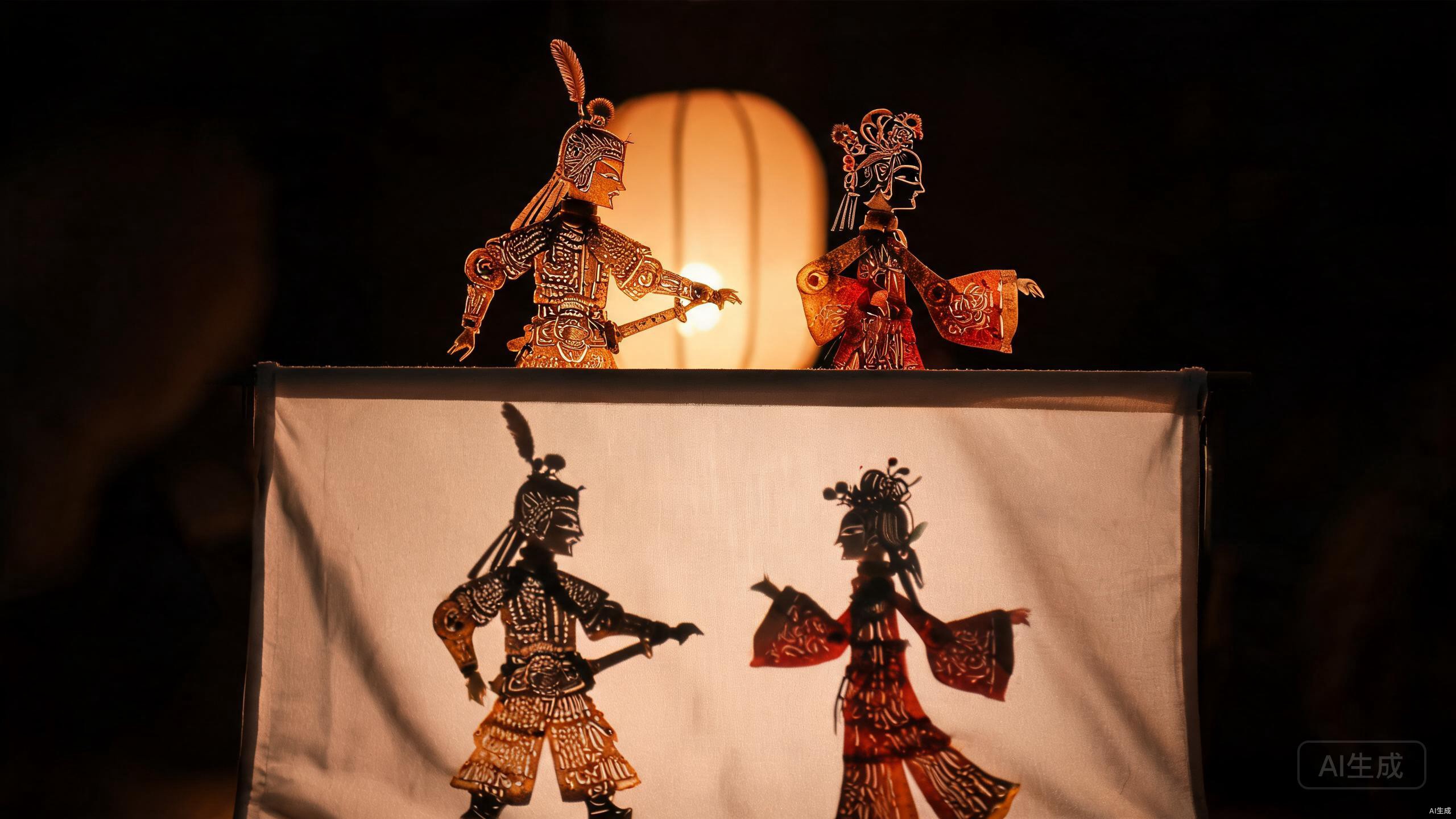
# The Complete History of Chinese Shadow Puppetry: 2000 Years of Light and Shadow
Few art forms on Earth carry the weight of two thousand years behind a single illuminated screen. **Chinese shadow puppetry** — known in Mandarin as *pi ying xi* (皮影戏), literally “shadow play of leather figures” — is one of those rare, living bridges between antiquity and the present day. It is part theatre, part visual art, part music, part engineering, and part philosophy. Before cinema, before photography, before the magic lantern shows of Europe, the storytellers of China were already casting light through hand-carved leather to conjure entire empires on a thin cloth screen.
This is the flagship historical guide for **puppetglow.com**, and our goal is simple: to give you the most complete, accurate, and engaging *shadow puppet history* available online. Whether you’re a student of world theatre, a collector of folk art, a filmmaker looking for forgotten techniques, or simply a curious traveler who once saw a glowing figure dance on a rice-paper screen in a Beijing alleyway — this article will walk you through every major chapter of the *traditional shadow theater* tradition, from a heartbroken emperor and his dead beloved, all the way to a UNESCO-recognized intangible heritage that still flickers today.
> **A note on this guide:** Throughout the article, you’ll see `[RECOMMENDED PRODUCT: xxx]` placeholders. These mark categories of gear and collectibles that pair naturally with the section you’re reading — perfect if you want to start your own collection, build a home shadow-play setup, or simply dive deeper. We’ll be filling in curated affiliate picks as the site grows.
## What Is Chinese Shadow Puppetry? (And Why It Still Matters)
**Chinese shadow play** is a performing art in which flat, articulated figures — usually cut from donkey or ox hide, sometimes parchment or paper — are pressed against a translucent screen and lit from behind. A hidden puppeteer manipulates each figure with thin bamboo or metal rods, while singers, drummers, and *suona* (reed horn) players supply voices, music, and sound effects. The result, when done well, is something that resembles a moving painting come to life: generals ride horses, scholars debate, ghosts rise from tombs, and lovers reunite across lifetimes — all drawn from the great vernacular novels like *Journey to the West*, *Romance of the Three Kingdoms*, and *Investiture of the Gods*.
What makes *pi ying xi* important is not just its age. It is the **oldest continuous tradition of projected-image storytelling in the world**, and is widely regarded as a direct ancestor of cinema. The Chinese film historian Cheng Jihua and others have argued that the shadow theatre’s grammar of light, screen, narrative sequence, and audience-facing projection seeded the conceptual groundwork that would later bloom into motion pictures. When the Lumière brothers held their first public screening in 1895, the logic of “shadows on a wall” had already been refined by Chinese artisans for nearly two millennia.
It is also a folk art with remarkable technical depth. A single carved figure can have over thirty separately articulated joints. The leather is dyed with translucent mineral pigments so that, under lamplight, a green robe glows jade, a red robe burns ruby, and the embroidered clouds on a celestial maiden’s dress shimmer like stained glass. The carving tradition requires years of apprenticeship and a steady hand that can sever a single millimeter-wide line without tearing the whole hide. To watch a master carve is to watch someone draw with a scalpel.
[RECOMMENDED PRODUCT: Chinese shadow puppet collectible figure set]
Finally, *pi ying xi* matters because it represents something rare in modern culture: a **storytelling form that survived the rise and fall of dynasties, the printing press, radio, television, the internet, and the smartphone**. To understand its history is to understand how traditional arts can persist, mutate, travel, and — when given the chance — bloom again.
## Origins and Legends: The Emperor and the Dead Beloved
No history of *shadow puppet history* can begin without the legend of **Emperor Wu of Han** (汉武帝, reigned 141–87 BCE) and his beloved concubine **Lady Li** (李夫人). The story, recorded in sources such as the *Shiji* (Records of the Grand Historian) tradition and later retold in the *Soushen Ji* (In Search of the Supernatural) by Gan Bao, runs roughly as follows.
Lady Li, celebrated for her beauty and her family’s influence at court, fell ill and died young. The Emperor was inconsolable. He refused to eat, refused to hold court, and spent his nights staring into the shadows of his palace chambers. A Daoist adept or magician named **Shao Weng** (少翁) — sometimes identified as a方士, a “method master” or alchemist — approached the throne and offered to summon Lady Li’s spirit so the Emperor could see her one last time. He set up a tent of fine silk, lit candles behind it, and asked the Emperor to sit at a distance, alone, and watch.
After a time, a faint silhouette appeared on the silk — the outline of a woman walking, turning, sitting as Lady Li once had. The Emperor rose and tried to approach, but the magician warned him that to touch the spirit would break the spell. He sat back down, watched the figure drift across the cloth, and — depending on which version you read — either composed a grief-stricken poem or simply wept.
The poet Ban Gu, in the *Book of Han* (*Hanshu*), preserves a line often attributed to the Emperor after this vision: *”Is she come? Or is she not? She stands lightly, so slow, so fleet.”* Whether or not Shao Weng actually used a leather puppet, a reflected image, or simply a conjurer’s trick is unknowable. But the legend — usually dated around **121 BCE** — became the foundational myth of Chinese shadow theatre, and every regional troupe in later centuries traced its lineage back to that dim Han palace.
[RECOMMENDED PRODUCT: Hardcover book on Chinese folk theatre history]
The earliest *textual* evidence of shadow plays as an established entertainment, however, comes much later. References to “image plays” and “lantern shadows” appear sporadically in Tang-era texts, but the form clearly existed in folk settings long before elite scribes noticed it. Archaeological finds — including small carved leather figures recovered from Han and Wei tombs — suggest that the technical precursors of shadow puppetry (leather-cut figures, lamp-lit screens) may have been part of funerary, religious, and shamanic ritual for centuries before the imperial legend fixed it in cultural memory.
## Tang Dynasty Development: From Ritual to Popular Entertainment
By the **Tang Dynasty (618–907 CE)**, China was arguably the wealthiest and most cosmopolitan empire on Earth, and the conditions for a popular theatre were finally in place. Three developments during this period reshaped the trajectory of *Chinese shadow puppetry*:
1. **The rise of urban leisure culture.** Tang capitals like Chang’an and Luoyang had massive populations, busy entertainment quarters, and a paying public. Performers guilded themselves into professional associations called *yuehu* (乐户), and shadow performers were among them.
2. **The spread of Buddhism and the use of “transformation paintings” (*bianxiang*).** Buddhist temples told sutra stories through sequential painted images hung on cloth or projected in dim halls. These visual-narrative techniques bled directly into how shadow plays structured their scenes.
3. **Improvements in leatherworking.** Tang artisans refined the tanning and translucent dyeing of hide, allowing figures to glow with color rather than appear as flat black silhouettes.
Written references from the Tang describe performances called *yingxi* (影戏) and *zhan ying* (占影), often associated with telling stories of deities and historical heroes. A passage in the writings of the Tang official Duan Anshi mentions shadow shows being staged at temple fairs during the Zhongyuan (Ghost Festival) rites — appropriate, given that the form was long believed to communicate with the dead. By the end of the Tang, *pi ying xi* had largely moved from ritual and court to the marketplace.
[RECOMMENDED PRODUCT: DIY shadow puppet carving tool kit for beginners]
It is also worth noting that the Tang era’s love of large-scale spectacle — imperial banquets, plays with hundreds of performers, mechanical automata — provided shadow theatre with an aesthetic ambition that earlier periods had not. By the time the Tang collapsed, the stage was set (literally) for the explosion that would follow in the Song.
## Song Dynasty Golden Age: The First True Theatre
If the Tang gave *Chinese shadow play* a marketplace, the **Song Dynasty (960–1279)** gave it a profession, a stage, a paying audience, and a permanent home. This is the period historians point to as the unquestionable **golden age of shadow puppetry**.
The Northern Song capital of **Bianjing** (modern Kaifeng) was one of the largest cities in the world, and its entertainment district — known as the *washe* (瓦舍), or “tile markets” — was packed with theatres called *goulan* (勾栏). Among the many acts competing for crowds — acrobats, storytellers, opera singers, comic performers — shadow plays held a prestigious and beloved spot. The chronicler Meng Yuanlao, in his *Dongjing Meng Hua Lu* (东京梦华录, “Dreams of Splendor of the Eastern Capital”), lists named shadow troupes performing in the tile markets, including the famous **Sun Kuan troupe** and others whose reputations drew standing crowds every night.
When the Jurchen Jin invasion forced the Song court south in 1127, the capital moved to **Lin’an** (modern Hangzhou), and the southern city quickly became the new center of shadow theatre. The chronicler Wu Zimu, in his *Meng Liang Lu* (梦粱录, “Records of Dreams of Millet”), reports that Hangzhou had a thriving shadow community of specialists like Sir Ding, Sir Xiang, and others who refined the art to an extraordinary degree. A separate text, *Wulin Old Tales* (武林旧事), even catalogs named masters in a kind of theatrical directory.
Three things made the Song golden age genuinely transformative:
– **Standardization of repertoire.** Troupes performed long-form cycles drawn from the great vernacular and semi-vernacular tales — the *Three Kingdoms*, the rise and fall of the Five Dynasties, the journeys of monks to India, the heroic exploits of the Yang family generals. A full cycle could take weeks of nightly performance.
– **Musical codification.** The shadow stage adopted regional opera melodies as its score, paving the way for the later deep regionalization of the form.
– **Carving as fine art.** Song-era figures, as evidenced by surviving fragments and later copies, displayed astonishing craftsmanship — jointed limbs, translucent robes, intricate headdresses. Some surviving Song-style carvings are considered masterpieces of folk sculpture.
[RECOMMENDED PRODUCT: Vintage Song-style shadow puppet figure reproduction]
Crucially, the Song also saw the first attempts to **mechanize** the show. Passages describe rotating lamp holders, multiple screens for different scenes, and even attempts at simple moving scenery — arguably the earliest known narrative cinema technology in human history.
By the end of the Southern Song, *pi ying xi* was no longer a curiosity or a ritual remnant. It was a national popular entertainment, and its next move would be outward.
## Yuan and Ming Dynasty Spread: Shadows on the Silk Road
The **Yuan Dynasty (1271–1368)**, founded by the Mongols under Kublai Khan, was a disaster for many Chinese institutions but an unlikely accelerator for shadow theatre. The Mongol empire stretched from Korea to Persia to the gates of Vienna, and its officials, soldiers, and traders carried their entertainments with them.
Arabic and Persian sources from the 13th and 14th centuries describe a form of entertainment they called *Khayāl al-Zill* (خيال الظل) — “shadow imagination” or “shadow play” — which spread across the Islamic world during this period. Whether *Khayal al-Zill* was imported wholesale from China or developed in parallel is still debated by theatre historians like Metin And and Richard Pischel, but most agree that Chinese shadow theatre directly or indirectly influenced the Persian, Egyptian, and Turkish traditions that flowered in the centuries that followed. The most famous living descendant is the **Karagöz** theatre of Turkey, which remains a beloved folk art in Istanbul to this day.
During the **Ming Dynasty (1368–1644)**, the form continued its slow march westward. European travelers — including Jesuit missionaries returning from China — are reported to have brought back descriptions and, in some cases, specimens of Chinese shadow puppets. By the late 17th and 18th centuries, “Chinese shadow” shows had become a fashionable novelty in the courts of Europe, including the fabled **Chinese Shadow Theatre** staged for the French court under Louis XV. The great Chinese-shadow craze in Europe would peak a hundred years later, in the 19th century, when the **Cabaret du Chat Noir** in Paris (founded 1881) popularized the *ombres chinoises* — literally “Chinese shadows” — as a chic Montmartre entertainment.
[RECOMMENDED PRODUCT: Replica antique European “Chinese shadows” projection lantern]
Meanwhile, back in China, the Ming era consolidated *pi ying xi*’s place in everyday rural and urban life. Three features stand out:
– **The binding of shadow repertoire to vernacular novels**, especially *Journey to the West*, *Investiture of the Gods*, and *Romance of the Three Kingdoms*. This is when the iconic character types — the monkey king Sun Wukong, the heroic Liu Bei, the traitorous Cao Cao — became codified in their carved form.
– **The growth of regional carving styles**, foreshadowing the great regional schools of the Qing.
– **The institutionalization of family troupes**, where carving skills, scripts, and music were passed father-to-son across generations, often with strict secrecy about the family’s signature techniques.
By the end of the Ming, *Chinese shadow play* was no longer one art — it was dozens, each embedded in the language, music, and folklore of its own region.
## Qing Dynasty and Regional Schools: A Thousand Local Traditions
The **Qing Dynasty (1644–1912)** was paradoxically the most splendid and most precarious era for *traditional shadow theater*. On one hand, the form reached its zenith of craftsmanship, regional diversity, and popular affection. On the other, the social upheavals of the late Qing — famines, rebellions, the Taiping War, foreign incursions — would begin the long, slow decline that defined the 20th century.
What most distinguishes Qing-era *pi ying xi* is the **flowering of distinct regional schools**, each with its own carving style, screen size, musical accompaniment, vocal technique, and preferred repertoire. The major traditions include:
### Shaanxi Shadow Puppetry (陕西皮影)
Often considered the **birthplace and oldest continuous tradition** of Chinese shadow theatre, Shaanxi shadow is divided into several sub-schools, most notably:
– **East Road (东路)**, centered on Weinan and Huazhou, known for delicate carving and elaborate opera-style singing.
– **West Road (西路)**, centered on Fengxiang and Baoji, with bolder, more rustic figures and a faster musical tempo.
– **North Road (北路)** and southern variants, each with distinctive puppet heights (some as tall as 50 cm).
Shaanxi shadow figures are famous for their **profile carving** — the figures are cut with one eye, half a nose, and a curved mouth, following a formula described in the old saying *”one eyebrow, one eye, half a mouth”* (一眉一眼半口). The leather, often donkey hide, is dyed in jewel-tone translucent pigments: cinnabar red, orpiment yellow, azurite blue, malachite green.
[RECOMMENDED PRODUCT: Authentic Shaanxi-style carved donkey-hide shadow figure]
### Tangshan Shadow Puppetry (唐山皮影)
From Hebei Province, Tangshan (also called Luanzhou) shadow is arguably the most internationally famous of all the Chinese schools. It features slightly smaller, finer-featured puppets with elegant, fluid movements and a distinctive high-pitched falsetto singing style called *Luanzhou tune*. Tangshan shadow was the form most often shown to foreign dignitaries in the 20th century, and many of the figures that ended up in Western museum collections are Tangshan pieces.
### Sichuan Shadow Puppetry (成都皮影)
Chengdu shadow, also called **Sichuan shadow**, is known for unusually large figures — sometimes over 60 cm tall — with bold, theatrical faces and an opera style heavily influenced by Sichuan opera’s *bianlian* (face-changing) and *gaoqiang* (high-pitched) singing. The repertoire leans heavily toward local folktales and the wild, comic, and grotesque stories of the Sichuan vernacular tradition.
### Beijing Shadow Puppetry (北京皮影)
A court-inflected tradition with two main lineages — the **Lu (路) family school** and the **Liu (刘) family school** — Beijing shadow features refined, courtly figures, a relatively restrained carving style, and music drawn from Beijing opera. The Beijing form was historically patronized by the imperial household and the Manchu aristocracy, giving it a polish and elegance distinct from the rougher folk traditions.
### Other Notable Schools
– **Gansu (环县道情皮影)** — famous for its Daoist-flavored singing (*daoqing*) and intimate, almost liturgical atmosphere.
– **Shandong (泰安皮影)** — known for robust, dramatic figures.
– **Hubei (江汉平原皮影)** — southern-style figures with papercut influence.
– **Hunan (湖南纸影)** — distinctive for using **paper** rather than leather, a tradition rooted in the cheap, abundant paper of the region.
– **Liaoning (辽南皮影)** — northeastern tradition with strong Manchu-Chinese fusion.
A 1950s survey by Chinese folklorists counted more than **50 distinct regional schools** of *pi ying xi* across the country. This regional diversity — comparable in scale to the regional operas — is one of the great cultural treasures of late-imperial China, and a primary reason the form is now considered so irreplaceable.
[RECOMMEND PRODUCT: Beginner’s handbook of regional Chinese shadow schools]
## Decline and Preservation: Shadows in the Modern Storm
The long, slow decline of *Chinese shadow puppetry* began in the late 19th century and accelerated through the 20th. The causes are sadly familiar to anyone who studies traditional arts:
– **Warfare and instability.** The Taiping War (1850–64), the Boxer uprising, the fall of the Qing, the Warlord Era, the Japanese invasion, and the civil war all devastated rural communities that had sustained family troupes for generations. Many master carvers and performers died without transmitting their skills.
– **New entertainments.** Cinema, gramophones, radio, and eventually television displaced shadow theatre as the dominant popular entertainment. By the 1930s, surviving troupes were reduced to itinerant performers playing at temple fairs and funerals.
– **The Cultural Revolution (1966–76).** Like most “old customs,” shadow puppetry was persecuted. Puppets — many of them irreplaceable centuries-old carvings — were publicly burned as “feudal artifacts,” troupes disbanded, and masters publicly humiliated. The loss was catastrophic; the surviving Tangshan master Wang Baoqiang and the Shaanxi master Chen Lanru were among the few who protected their family collections by burying them or hiding them in walls.
Yet preservation efforts never quite died. A few key threads kept the art breathing through the worst decades:
– **Folklorists and academicians.** Scholars at the nascent Chinese Academy of Folk Theatre began documenting scripts, carving techniques, and musical scores in the 1950s and again in the 1980s.
– **State-sponsored troupes.** From the 1950s onward, provincial governments formed official shadow troupes that toured abroad and performed for diplomatic events, keeping at least a thin thread of the tradition alive.
– **Family lineages.** A handful of stubbornly devoted families — the Wangs of Tangshan, the Bais of Shaanxi, the Lus of Beijing — refused to abandon their inheritance, even when it brought them political persecution and poverty.
By the 1980s, when China began to recover from the Cultural Revolution, fewer than a few hundred active masters remained across the entire country. The art that had once numbered its performers in the tens of thousands had been reduced to a fragile ember.
[RECOMMENDED PRODUCT: LED shadow-play backlight lamp for home practice]
## UNESCO Heritage Status: The World Recognizes Pi Ying Xi
On **November 27, 2011**, at the fifth session of the UNESCO Intergovernmental Committee for the Safeguarding of the Intangible Cultural Heritage, held in Bali, Indonesia, **Chinese shadow puppetry was officially inscribed on the Representative List of the Intangible Cultural Heritage of Humanity**. The official UNESCO entry, registered under the title “Chinese shadow puppetry,” describes it as a “performing art in which silhouettes of puppets are projected onto a white screen” and notes the form’s spread across China and its deep ties to regional folk culture, history, and craftsmanship.
The UNESCO recognition was not just ceremonial. It triggered:
– **Funding for preservation projects**, particularly in Shaanxi, Hebei, and Sichuan, where the major schools were most endangered.
– **Identification of “national-level inheritors” (国家级传承人)** — master performers officially recognized and supported by the state, who receive a small annual stipend in exchange for teaching apprentices.
– **International touring and exchange**, with Chinese shadow troupes appearing at major world festivals, museum exhibitions, and academic conferences.
– **Digital preservation projects**, including high-resolution scanning of antique puppets, recording of fading musical traditions, and digital archiving of scripts.
To date, dozens of masters have been recognized at the national and provincial level as inheritors of *pi ying xi*, and major museums — including the **China National Museum in Beijing**, the **Shaanxi History Museum**, the **Tangshan Shadow Puppet Museum**, and the **British Museum** — hold significant collections of antique shadow figures.
[RECOMMENDED PRODUCT: Coffee-table book on UNESCO intangible cultural heritage of China]
But UNESCO status is also a sobering reminder. Recognition often comes just in time to preserve a dying thing; it is not the same as vitality. The next chapter — the modern revival — would have to do the harder work of making *pi ying xi* matter again to new generations.
## Modern Revival and Global Influence: Shadows in the 21st Century
The 21st century has been — tentatively, unevenly, but unmistakably — a period of **revival for Chinese shadow puppetry**. The forces driving this revival come from several directions:
### Animation and Cinema
Chinese animators, particularly the legendary **Shanghai Animation Film Studio**, drew heavily on shadow aesthetics in classics like *The Magic Brush* (1955) and *Monkey King: Uproar in Heaven* (1961–64). More recent independent animation, including the work of artists like Sun Xun, has drawn on shadow aesthetics to create distinctive avant-garde films. Internationally, directors from Lotte Reiniger (whose 1926 *The Adventures of Prince Achmed* was the first surviving animated feature) to contemporary motion designers have explicitly cited Chinese shadow theatre as a major inspiration.
### Stage and Cross-Cultural Performance
Modern theatre directors in China and abroad have integrated shadow techniques into contemporary stage works. Notable examples include the National Theatre of China’s productions of classical plays, cross-cultural collaborations with European shadow theatre companies like **Theatre Pcancel** and **The Forbidden City** at the Edinburgh Festival, and the rise of new touring troupes that perform *pi ying xi* in dialogue with Western puppet theatre traditions.
### Tourism and Cultural Heritage
In tourist hubs like Xi’an, Chengdu, and Beijing, dedicated shadow-play theatres have reopened, often in restored historical venues, offering nightly shows for visitors. These performances sometimes lean toward accessibility — shorter, with English narration, sanitized for international audiences — but they also train new performers and pay new apprentices, helping sustain the craft.
### Education and Apprenticeships
Universities and folk art institutes now offer formal courses in shadow puppet carving, performance, and music. The **Xi’an Academy of Fine Arts** has a respected shadow-carving program, and several masters take on small cohorts of dedicated apprentices. There are also children’s workshops across the country that teach simplified shadow-carving using paper and craft knives — a far cry from donkey hide, but a meaningful gateway.
### Digital and Online Reach
YouTube, Bilibili, Douyin, and Instagram have given master shadow performers a global audience for the first time. Short clips of masterful carving — the precise movements of the small knife, the translucent glow of dyed leather — routinely go viral, introducing millions of viewers to the form. Museum digitization projects, especially the **Smithsonian’s digitization of Chinese shadow figures** in its Freer/Sackler collection, have made high-resolution images freely accessible worldwide.
[RECOMMEND PRODUCT: Beginner-friendly paper shadow puppet starter kit for kids and classrooms]
### Challenges Remain
Yet this revival is fragile. The masters who survived the 20th century are now very old, and many have died without fully transmitting their craft. Pay in the field remains low, and most young apprentices must hold day jobs. Commercial pressures sometimes push productions toward tourist kitsch rather than authentic art. And while the form is no longer at imminent risk of extinction, it is far from the living, popular tradition it was a century ago. The next decade will likely determine whether *pi ying xi* settles into a comfortable, museum-ized survival — or genuinely finds a new place in 21st-century culture.
The signs, on balance, are hopeful. A folk art that survived the Han, the Tang, the Song, the Mongol Yuan, the Ming, the Qing, the warlords, the Cultural Revolution, and the arrival of cinema is unlikely to die quietly in the age of the internet.
## Conclusion: A Light Still Lit
The story of **Chinese shadow puppetry** is, in miniature, the story of all traditional arts: a fragile, beautiful thing carried across two thousand years on the backs of stubborn, devoted, often anonymous people. It began (if we believe the legend) with a grieving emperor and a magician’s trick of light, was professionalized in the tile markets of the Song, traveled the Silk Road into Arabic and European imaginations, splintered into dozens of regional dialects in the Qing, was nearly burned to ash in the 20th century, and was lifted back onto the world stage by UNESCO in 2011.
To learn about *shadow puppet history* is to learn how an art survives: by adapting, by regionalizing, by refusing to be only one thing. *Pi ying xi* is not a museum piece frozen in amber — it is a living conversation between light, leather, story, and human patience. It is, in a real sense, the great-grandmother of every movie ever projected on a screen.
If this article has done its job, you now see those glowing silhouettes on rice-paper screens a little differently — not as a quaint tourist novelty, but as the last flickering chapter of one of humanity’s oldest narrative technologies. We hope you’ll keep exploring with us at **puppetglow.com** as we build out guides to regional styles, carving tutorials, collector spotlights, and in-depth profiles of the masters still working today.
The lamp is still lit. The screen is still white. And somewhere, right now, a carved leather general is raising his sword.
## Frequently Asked Questions (FAQ)
Below are answers to the most common questions readers ask about Chinese shadow puppetry. These are formatted for **FAQPage schema** to make them easy to find in search results.
**Q1: What is Chinese shadow puppetry?**
**A1:** Chinese shadow puppetry (*pi ying xi*, 皮影戏) is a traditional Chinese performing art in which flat, articulated figures carved from translucent leather (usually donkey or ox hide) are pressed against a backlit screen and manipulated with rods to enact stories. It is accompanied by singing, percussion, and reed-horn music, and is widely considered one of the oldest forms of projected-image storytelling in the world — and a direct conceptual ancestor of cinema.
**Q2: How old is Chinese shadow puppetry?**
**A2:** The legendary origin is dated to around **121 BCE**, during the reign of Emperor Wu of Han, when a magician named Shao Weng reportedly conjured the silhouette of the dead Lady Li on a silk screen. As a fully developed popular entertainment, *pi ying xi* is documented from the Tang Dynasty (618–907) and reached its golden age in the Song Dynasty (960–1279), making the tradition at least 1,000 and possibly over 2,000 years old.
**Q3: What materials are traditional Chinese shadow puppets made from?**
**A3:** Traditional puppets are carved from **tanned donkey or ox hide**, dyed with translucent mineral pigments (cinnabar, azurite, orpiment, malachite) so they glow with color when backlit. Each figure is articulated with dozens of small joints and operated by thin bamboo or metal rods. Some southern traditions, especially in Hunan, use **paper** rather than leather.
**Q4: What are the main regional schools of Chinese shadow puppetry?**
**A4:** The most important regional schools are **Shaanxi** (considered the birthplace, with East, West, North, and South sub-schools), **Tangshan (Hebei)** known for its elegant figures and high-pitched falsetto singing, **Sichuan (Chengdu)** with its unusually large figures, **Beijing** with its courtly refinement, and numerous others including Gansu, Shandong, Hubei, Hunan, and Liaoning. Folklorists have catalogued more than 50 distinct regional traditions.
**Q5: Is Chinese shadow puppetry a UNESCO intangible cultural heritage?**
**A5:** Yes. **Chinese shadow puppetry was inscribed on UNESCO’s Representative List of the Intangible Cultural Heritage of Humanity in 2011**, in recognition of its long history, regional diversity, and significance as a living folk tradition. The status has triggered preservation funding, identification of national-level inheritors, and international touring support.
**Q6: How does Chinese shadow puppetry relate to cinema?**
**A6:** Many film historians consider *pi ying xi* a **direct conceptual ancestor of cinema**. It was the first art form to combine a backlit screen, sequential narrative scenes, projected moving images, and a paying audience. When the Lumière brothers held their first public film screening in 1895, the underlying logic of “shadows on a wall” had already been refined by Chinese artisans for nearly two millennia.
**Q7: Where can I see Chinese shadow puppetry today?**
**A7:** Live performances are staged regularly at dedicated shadow theatres in **Xi’an, Beijing, Chengdu, and Tangshan**, as well as at temple fairs and folk festivals across China. Internationally, touring troupes appear at major theatre festivals and museum exhibitions. Online, high-resolution digitized collections and performance clips are available through the **Smithsonian’s Freer/Sackler Gallery**, the **British Museum**, and the **China National Museum**, as well as on YouTube and Bilibili.
*This article is part of puppetglow.com’s flagship guide series on Chinese shadow puppetry. Look for our upcoming deep dives into regional carving styles, master profiles, and beginner-friendly carving tutorials.*